
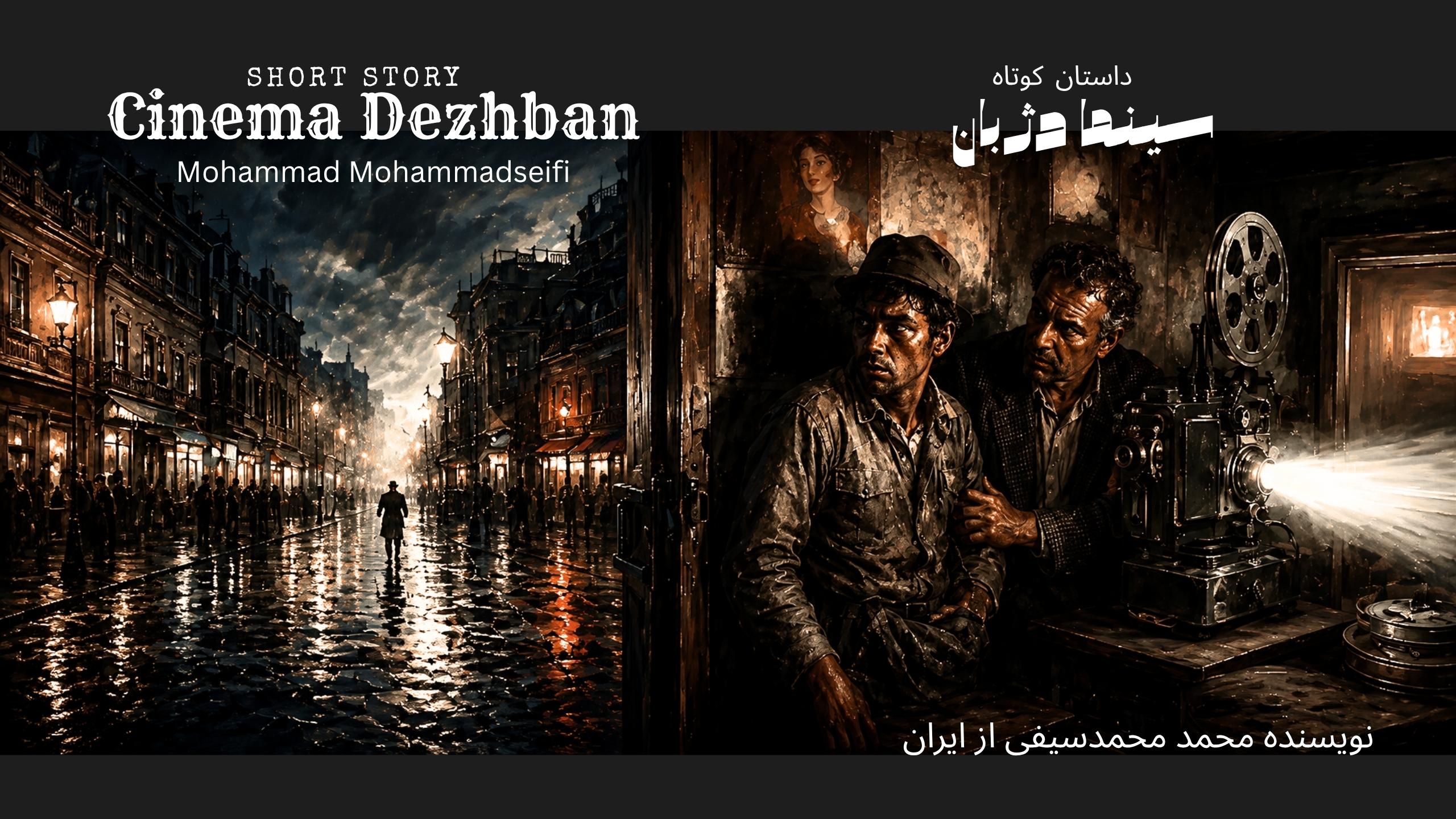
Cinema Dezhban
Short Story
By Mohammad Mohammadseifi محمد محمدسیفی
You come off Berlin Street into Lalehzar with your cap off as always, the coarse dust-colored army shirt hanging loose over your trousers, walking slowly toward the stop of the green double-decker buses at Tupkhaneh Square. Most of the shops are closed, but the peddlers have spread their wares along the corners of the sidewalk. There is nothing worth a second glance: secondhand electrical goods, glass-fronted boxes crammed with cheap perfumes, oversized rings and switchblades. A few have pinned posters of landscapes and foreign movie stars to the rolled-down shutters of the closed shops.
You are standing before a poster of Charles Bronson in Red Sun, his revolver aimed straight at you and a foolish grin on his lips, when, reaching the photographs of Alain Delon, you notice the military police, the dezhban, on the far side of the street. Quickly you put on the army cap and bend its visor down over your forehead. The old man pasting posters to the walls stops working and stares at you. In fact the whole sidewalk is watching you, as if they already know what is about to happen; perhaps they have watched soldiers seized by the MPs many times before. One of the MPs points you out to his partner, and only now do you remember that you have left your leave pass back at the barracks. For a few moments the images line up in your head: arrest by the MPs, the cells of Central Dezhban, your sister's worried face, she who sits by the front door every Friday waiting for you to come, and her children, who always spot you from far off and run toward you with joy... The taste of the chocolate in your mouth turns bitter and more bitter, and suddenly you decide to run. The MPs, for whom this seems to be routine work, read your hand and break into a run. You step off the sidewalk into the street and run toward Tupkhaneh, shouldering past pedestrians, deaf to their curses, still running, when suddenly a hoarse voice rings out across the street:
"Mashallah! Bless those lungs... you're leaving them behind, champion!"
It sounds like the old poster-seller. When you enter the cinema you are ready for anything except hiding in that little room to escape the stubborn MPs who have found themselves a fine catch. You walk in. The ticket booth is closed, but the big glass door has been left ajar; you slip through the gap, and the cleaner appears before you like the angel of death with a wet, filthy mop, sliding the big rag-like strips stapled to a rusty pole across the red mosaic tiles toward your boots, and asks, sour and cutting: "Where to, slop-eater?"
Slop-eater is the hateful word officers and NCOs use to humiliate conscripts. Sometimes the senior soldiers use it on the new arrivals too, so that, as they put it, a man knows this is no free-for-all and the old-timers have their rights of seniority.
When you leave the barracks, one of those old-timers sticks his head out of a second-floor window of the dormitory and yells: "Watch out for the MPs, slop-eater!"
And you only wave your cap at him. It is a signal. With that gesture you remind him of a month ago when, on Jomhuri Street, he fell without warning into the hands of one of these same MPs, capless at that, and of the three days of extra duty that have sat on his file ever since like a brand of shame. Warrant Officer Mollashahi has promised to wipe the extra duty of all the boys in the services unit, but nobody believes a word he says; he has fed the poor conscripts so many lies and fleeced every one of them with some promise or other. The rumor everywhere is that before the revolution he was a SAVAK informer inside the army and that any day now he will be purged. And how lucky you are that, as he himself puts it, his soap has never yet touched your skin! After days of guard duty and drudgery you need a long rest, and where better than your sister's house in Tehranpars, and the room that is always tidy and that her children have named after you.
He pulls you along toward the stairs that climb to the cinema balcony. You go with him, no questions asked. He is a stranger, yet something in his manner and his gaze reminds you of someone who was once your whole world. He grips your hand firmly, and you go along like a suspect who has confessed to his crime. You glance behind you; still no sign of the furious MPs. You turn toward the balcony, and he all but shoves you, pulling you with him into the projection room.
"It's safer here, soldier!" He does not wait for your answer and goes back as fast as he came. No doubt to scout around.
The projectionist is no more than forty. He says so himself.
"I saw you out there with the MPs after you, but I didn't know you'd come into this cinema. Truth is, you did right. Even if you'd run all the way to Tupkhaneh they'd have caught you. It's what they do!"
And then, with a smirk: "Well! What can you do?! Every man has his trade!"
He passes by you where you sit on the leather couch and loads the big film reel into the idle projector. When he flips the switch, the frames wind onto the empty reels, and all you can see are fleeting shadows on the moving strip of film. The people on it keep changing places, as if they too were fleeing from one another. He lifts the teapot off the smoke-blackened kettle, pours himself a glass of straight dark brew, and grins at you.
"Tea?"
He does not wait for your answer, fills a glass halfway for you, and lifts the kettle from the Aladdin heater. The kettle is empty. Annoyed, he tosses it into a corner.
"No help for it! You'll drink it strong and dark!"
Beside the saucer he sets two or three sugar cubes, draws a small plastic bag from the breast pocket of his checked jacket, and laughs again, this time a little sheepishly.
"This stuff is my Plato's elixir!"
He pinches off a piece of the opium paste, drops it into his glass, downs the tar-black tea in one breath, then closes his eyes in a particular way, savoring the bitterness of the little piece of shireh in his mouth.
He takes your glass away.
"It's gone cold, let me change it. Tea must scald the lip, seal the lip, and brim over the lip." He laughs again. The back of his tongue is coated with a blackish film and his tartared teeth have gone yellow. From a silver tin he takes an oval Homa cigarette, taps it twice on the back of his hand, lights it from the heater's flame, takes a hard drag, and offers you one.
"Not a smoker, are you?"
You answer with a shake of your head.
"Well! Thank God! It's a wretched poison, this damned smoke; it blows a man's life to the wind!"
You sit facing him like one big question mark, asking yourself why this man should help me without even knowing me. Who is to say he has no schemes in his head? Major Qamari's words ring in your ears: "Outside the barracks, trust no one! Enemy spies are everywhere. They have fine methods for draining information out of you; they come close like an old friend and soften you up with their talk, and then the trouble begins... the soup untasted and the mouth already burnt!"
The projectionist cracks the door open and calls the cleaner.
"Hey! What happened? Are they gone?"
The cleaner's answer from down below is unintelligible. The man comes back into the room, upset.
"Damn the luck!"
He sets the full kettle on the heater and stubs his cigarette out in the saucer.
"Mammad says they've gone into the hall. They must be searching the whole place."
You go with him to the small hatch that opens onto the auditorium. The usher walks ahead with a flashlight and one of the MPs follows behind. In the darkness you can see only the shadow of one of them. He stops beside a spectator who looks like a soldier, takes the usher's flashlight, and checks the man's papers. Your heart is in your mouth. You turn and say to the projectionist: "Now is the best time to run!" He cuts you off.
"Think you're dealing with a pair of fools?! No, brother! They know their business; one of them is posted at the cinema door so that the moment your foot touches the street he can collar you right there!"
You look at him in despair.
"Then how do I get out of here?!"
He turns down the heater's flame and wipes his nose with a small handkerchief.
"You'll have to wait till the film ends."
Only now do you notice the film on the screen. You look through the same small hatch: Faramarz Gharibian and Nematollah Gorji are in the frame. Gharibian drags his bloodied hand along the wall of Badr High School. The projectionist comes closer and opens the hatch all the way. Gharibian steps out of a taxi and sets off toward Lalehzar. Seyyed's voice comes over the loudspeaker, touting the Barbad Theater.
"Hurry, hurry! Tonight and every night, the musical spectacle Hitler's Wrath, or The Cheeky Maid!"
Ghodrat, in that American field jacket, with the mustache and the glasses, looks more like a guerrilla than a thief. Seyyed, who has not recognized him, looks him over.
"You want something, brother?! At your service! What is it? Need anything?"
Ghodrat introduces himself. Seyyed is stunned. They embrace. Ghodrat wants a place to hide, and Seyyed answers: "I've got a room, a ruin really... it's yours!"
The projectionist takes his eye from the hatch and points to the reel gliding over the sprockets.
"It's The Deer! Masoud Kimiai made it. His work is something else! Especially his Qeysar. Have you seen Qeysar?"
"No! But deer I've seen, back in our own town; plenty of times!"
He lights another cigarette and shows you the poster of Ghazal.
"Kimiai made this one too, but I didn't care for it. It wasn't like his other films. His biggest mistake was putting Fardin in front of the camera looking like that! Fardin was always clean and sharp, face shaved and trim, not wrecked like that! I remember at the first showing, the audience tore up all the seat covers in protest. They wanted their own hero, you see? I'd seen Fardin up close myself, on Arbab Jamshid Street. In the old days most of the studios and film companies were there; on Arbab Jamshid, the film-struck haunted the pavements and the teahouses day and night."
When he speaks of Arbab Jamshid, his eyes shine. His gaze is on the hatch, and he seems to be talking to himself.
"My misery began on Arbab Jamshid Street. I'd come with one smart suit to become a movie star. Those first days I didn't know who was who; I was just happy to see in the flesh the actors I'd only seen on the screen. The moment one of them stepped out of a car, the crowd would climb all over him. All they wanted was extras, and mind you, even the extras had their own pecking order.
"A few months on, our turn finally came. I was to take a beating from a policeman in some film. The day before, the director told me: you've got the look and the build! Made for action pictures! And I was floating in the clouds. The next day I went to the shoot with a few of the neighborhood boys. That's where I saw how heartless the cinema is: at lunch they'd got us flatbread with a scrap of halva while they gorged themselves on chelo-kabab soltani with Coca-Cola!
"The actors treated us like lepers; no respect, no courtesy. The one decent soul among them was Miss Pouri Banayee, a real lady. I heard from the boys that on set she was forever thinking of the extras and the stagehands, and in grace and dignity she stood head and shoulders above the rest... In the end it was she who told me I'd best go back to some work I knew, some craft I had... But well! We'd never had proper schooling; that's how we ended up idle and without a trade, a dead weight on society!
"Anyway, not to bore you. It was the seventh or eighth day when my turn came, and off I went before the camera with every blessing, but the director hadn't yet called action when the actor, that same policeman, laid into me and beat me black and blue. And I, disgraced in front of my friends, I don't know how it happened, but I ducked in, caught his leg, and slammed him to the ground! I'd been a wrestler in my youth. Don't judge by the state of me now! In short, in the middle of the shoot such a riot broke out as you've never seen. It turned out the man playing the policeman really was a policeman; so they sent me packing on the spot, and I wandered back to Lalehzar, adrift. For a while I was a cleaner at Cinema Alborz. My father, God rest him, from the day he learned I'd gone into the cinema, had said: you'll not set foot in my house again! So at night I slept right there, in the cinema; until at last, with my laborer's wages, I bought a motorbike on installments and became a film-runner, carrying reels between cinemas. That trade didn't suit me either. One day on Ferdowsi Street I collided with an army truck and lay a whole month in the hospital. When they discharged me I went straight back to Arbab Jamshid, but no one would give me work anymore. They all somehow thought me a jinx. Hard days those were; until through an acquaintance I was introduced to Mr. Manouchehri, the true owner of this very cinema, light rain upon his grave! A gentle soul he was... Oh brother! This one's settled in for the night; it seems catching you was only his excuse!"
You half rise from your seat. In the right corner of the auditorium, just beneath the small exit sign, the MP, whose big white cap betrays him in the dark, stands watching the film, so lost in it that he seems in no hurry at all to leave. You sink back onto the couch in despair. The projectionist sets another reel on the projector, turns it by hand, threads the strip of film through the sprockets with matchless skill, and takes up his talk again.
"Even Lalehzar isn't the old Lalehzar. It's gone quiet and dark. Plenty of the cinema owners went bankrupt. Some got their permits, knocked their cinemas down and built shopping arcades in their place. This cinema's on its deathbed too. When the films are no good, a cinema can't thrive. A few months back we ran The Senator. A good film. And honestly, it sold! But that Rifleman, the one with Fakhimzadeh and Davoud Rashidi, didn't sell at all. On the fifth day, when we came to run the show, the ticket man told us he'd sold exactly twenty-four tickets! You can't screen a film for twenty-four people in an eight-hundred-seat hall. It doesn't pay; we did the sums and found that even the electricity this projector burns wouldn't come back."
Again he leaves his sentence unfinished and hurries out, leaving you alone in the half-dark room. Carefully you open the hatch. Seyyed and Ghodrat are sitting at the spread cloth. Ghodrat watches Seyyed with devotion. Seyyed, his face sweat-soaked and wasted by the fire of the opium, stares at the ground. Ghodrat says something and they both laugh, but Seyyed, caught between weeping and laughter, says: "When I cry, I begin to hope there's still life in me."
And you, heavy with sleep, sprawl on the couch. The projectionist returns. Seyyed raises his glass.
"Anyway, you've brought joy with you!"
"To the old days!"
That is Ghodrat.
You shift on the leather couch and say, ashamed: "I've been a real burden on you!"
He sets the film reel on the table.
"Burden? What burden, I'm at your service! Make yourself at home! You're dead on your feet; plain to see they've worked you to the bone."
Seyyed examines Ghodrat's wound. Ghodrat keeps gazing at his old friend, tenderly following his every movement. Seyyed draws the shirt back from the wound.
"That's some wound! At your service, faithful one!"
The projectionist sets a small box of pastries before you.
"Go on, sweeten your mouth, brother!"
You turn and look at him with affection. He flees your gaze and busies himself splicing pieces of film together, and you go back to the hatch to watch the rest of the picture. Perhaps you also mean to drive the sleep out of your head. Seyyed goes after the dealer, and in the long half-dark corridor, with his white-handled Zanjani knife, he finishes Asghar's business. Asghar the dealer lies dying beside the courtyard pool. His wife screams and runs toward him. Seyyed sits beside Ghodrat and tells him what has happened. Ghodrat keeps smiling at him. The MP is no longer in the auditorium, and you are glad to be rid of him at last.
Seyyed nears the house. A large detail of policemen stands ranked along the alley, and Seyyed, without fear or dread, passes through them to reach the door of the big house. Someone kicks the door of the projection room, and you know it must be that MP who stood watching the film in the hall.
The blows grow harder. Seyyed reaches the courtyard and calls out to his friend. Ghodrat does not want Seyyed to throw himself into this deadly game. The policemen lie in ambush on the surrounding rooftops. The pounding on the projection-room door grows louder. The projectionist stands, reel in hand, and motions you to keep silent. You rise from your place, and your own voice echoes in your ears:
"Don't bring trouble on yourselves! It's me they want."
Seyyed, shot now, still insists on reaching Ghodrat.
"No, brother! You don't seem to understand, this is my home! I've long wished my end would come some way that counts."
The pounding on the door grows fiercer. Someone outside shouts, threatening the projectionist. This time your mind is made up. You put on your cap, straighten your uniform, and make ready to go, and the projectionist plants himself before you, barring your way to the door.
Seyyed, his body torn, throws himself into Ghodrat's room.
"Brother! You've sold us far too short! Our bodies are ruined; our friendship's gone nowhere."
At the roar of the explosion of Seyyed's house in the film, you stir on the couch and open your eyes. You see the projectionist standing over you. He smiles: "Soldier! The MPs are gone...!"
When you step out of the cinema, you feel fine drops of spring rain on your face. Night has fallen, and the beautiful reflection of light and color on the asphalt of Lalehzar reminds you of a film you watched once, though you cannot remember in which cinema.
سینما دژبان
داستان کوتاه
نوشتهٔ Mohammad Mohammadseifi محمد محمدسیفی
سینما دژبان
از خیابان برلن وارد لالهزار میشوی و مثل همیشه کلاه را از سرت برداشتهای، پیراهن زمخت خاکیرنگ سربازی را روی شلوار انداختهای و بهآرامی بهسوی ایستگاه اتوبوسهای دوطبقهٔ سبزرنگ در میدان توپخانه میروی. بیشتر مغازهها بسته است، امّا دستفروشها در گوشههای پیادهرو بساط پهن کردهاند. در بساطشان چیز دندانگیری نیست. لوازم دستدوم برقی، جعبههایی که درهای شیشهای دارند و پر شدهاند از عطرهای ارزانقیمت و انگشترهای درشت و چاقوهای ضامندار! چندتایی هم پوسترهای مناظر و شخصیتهایی از ستارگان خارجی به درهای کرکرهای مغازههای تعطیل زدهاند.
روبهروی پوستری از چارلز برانسون در فیلم آفتاب سرخ ایستادهای که هفتتیرش را به طرفت نشانه رفته است و خندهٔ ابلهانهای بر لب دارد. وقتی به عکسهای آلن دلون میرسی، متوجّه حضور دژبانها در آنسوی خیابان میشوی! سریع کلاه سربازی را بر سرت میگذاری و نقابش را تا روی پیشانی خم میکنی. پیرمردی که پوسترها را به دیوارها میزند، دست از کار میکشد و به تو زل میزند. اصلاً همهٔ عابران پیادهرو تماشایت میکنند. انگار از قبل میدانند قرار است چه اتّفاقی بیفتد، شاید هم بارها شاهد دستگیری سربازها توسّط دژبانها بودهاند. یکی از دژبانها با دست تو را به رفیقش نشان میدهد و تو تازه یادت میآید که دفترچهٔ مرخّصی را هم در پادگان جا گذاشتهای! برای چند لحظه، تصاویر ذهنی پشت سر هم ردیف میشوند؛ دستگیری توسّط دژبانها و رفتن به زندان دژبان مرکز و چهرهٔ نگران خواهرت که مثل همیشه، جمعهها، دم در خانه نشسته و منتظر است تا بیایی و بچّههای خواهرت که همیشه از همان دور با خوشحالی به سویت میدوند... طعم شکلاتی که در دهان داری، تلخ و تلختر میشود و ناگهان تصمیم میگیری که فرار کنی. دژبانها که به نظر میرسد این کار همیشگیشان باشد، دستت را میخوانند و به سویت میدوند. از پیادهرو وارد خیابان میشوی و به سمت توپخانه میدوی، به رهگذران تنه میزنی و بیتوجّه به ناسزاها همچنان میدوی که ناگهان صدای خَشداری در خیابان طنینانداز میشود.
ـ ها ماشاالله! بنازم به اینهمه نفس... داری جاشون میذاری دلاور!
به نظرت صدای همان پیرمرد پوسترفروش است. وقتی وارد سینما میشوی، منتظر هر اتّفاقی هستی، بهجز مخفی شدن در آن اتاق کوچک، برای فرار از دست دژبانهای سمجی که شکار خوبی به چنگ آوردهاند. وارد سینما میشوی. باجهٔ بلیتفروشی بسته است، امّا درِ بزرگ شیشهای نیمهباز مانده است. با شتاب از لای در رد میشوی که نظافتچی مثل اجل معلّق با تی خیس و کثیف جلویت سبز میشود و تکّههای بزرگ پارچهمانندی را که به میلهٔ زنگزدهای منگنه شده، از روی موزاییکهای قرمزرنگ سُر میدهد طرف پوتینهایت و تلخ و گزنده میپرسد: «کجا آشخور؟!»
آشخور کلمهٔ نفرتانگیزی است که افسران و درجهداران برای تحقیر سربازان به کار میبرند. گاهی وقتها هم سربازهای قدیمی و ارشد، سربازان جدید را با این عنوان میخوانند تا به قول خودشان طرف بداند اینجا هرکیهرکی نیست و قدیمیها همیشه حقّ آبوگل دارند!
وقتی از پادگان بیرون میآیی، یکی از آن سربازهای قدیمی سرش را از پنجرهٔ طبقهٔ دوم آسایشگاه بیرون میآورد و داد میکشد: «مواظب دژبانها باش آشخور!»
و تو فقط کلاهت را برایش تکان میدهی. این یک علامت است. با این حرکت او را به یاد یک ماه پیش میاندازی که در خیابان جمهوری، ناغافل، گیر یکی از همین دژبانها افتاد؛ آنهم بدون کلاه و سه روز اضافهخدمتی که مثل داغ ننگ روی پروندهاش مانده است. اگرچه ستوانیار ملّاشاهی قول داده همهٔ اضافهخدمت بچّههای یگان خدمات را پاک میکند، امّا کسی حرفهایش را باور ندارد. از بس که دروغودغل تحویل سربازهای بختبرگشته داده و هرکسی را با وعدهوعیدی تلکه کرده است. همهجا شایع شده که قبل از انقلاب خبرچین ساواک در ارتش بوده و همین روزهاست که تصفیه بشود! و تو چقدر خوششانسی که به قول خودش، تابهحال صابونش به تنت نخورده! بعد از چند روز نگهبانی و بیگاری، به استراحتی طولانی نیاز داری و کجا بهتر از خانهٔ خواهرت در تهرانپارس و اتاقی که همیشهٔ خدا مرتّب است و خواهرزادههایت نام تو را روی آن گذاشتهاند.
تو را با خودش میکشاند طرف پلّههایی که به سمت بالکن سینما میرود. همراهش میروی؛ بیهیچ سؤال و جوابی. با آنکه غریبه است، امّا رفتار و نگاهش تو را یاد کسی میاندازد که روزگاری همهٔ دنیایت بود. دستت را محکم میگیرد و تو مانند متّهمی که به جرمش اعتراف کرده باشد، با او همراه میشوی. نگاهی به پشت سرت میاندازی، هنوز خبری از دژبانهای عصبانی نیست. راهت را بهطرف بالکن کج میکنی که تقریباً تو را هل میدهد و با خود به اتاق آپارات میکشاند.
ـ اینجا امنتره سرکار!
منتظر جوابت نمیماند و با همان سرعتی که آمده برمیگردد. حتماً میرود سروگوشی آب بدهد.
مرد آپاراتچی چهل سال بیشتر ندارد. این را خودش میگوید.
ـ اون بیرون دیدمت که دژبانا دنبالت کرده بودن، امّا نمیدونستم که میآی تو این سینما. راستشو بخوای کار خوبی کردی. اگه تا توپخونه هم میدویدی، اونا بهت میرسیدن! اصلاً کارشون همینه!
و بعد با طعنه میگوید: «خب! چیکار میشه کرد؟! هرکسی یه شغلی داره دیگه!»
از کنار تو که روی مبل چرمی نشستهای میگذرد و حلقهٔ بزرگ فیلم را داخل آپارات خاموش جا میزند. کلید را که میزند، فریمهای فیلم دور حلقههای خالی میپیچند و تو میتوانی فقط سایههایی گذرا بر روی نوار متحرّک فیلم را ببینی. جای آدمها، مرتّب عوض میشود، انگار آنها هم دارند از هم میگریزند. قوری را از روی کتری دودزده برمیدارد و برای خودش چای یکرنگ میریزد و به رویت میخندد.
ـ چایی میخوری؟
منتظر جوابت نمیماند و برایت تا نیمهٔ استکان چای میریزد و کتری را از روی بخاری علاءُالدیّن برمیدارد. کتری خالی است، دمغ و ناراحت کتری را به گوشهای میاندازد.
ـ چارهای نیست! باید چایی یکرنگ بخوری!
کنار نعلبکی، دو سه تا حبّه قند میگذارد و از جیب کوچک کت چهارخانهاش، پلاستیک کوچکی بیرون میآورد و باز هم میخندد، امّا این بار با کمی شرمندگی.
ـ این حکم معجون افلاطون رو برام داره!
تکّهای از آن معجون را میکَند و داخل استکان میاندازد و چای به رنگ قیر درآمده را یکنفس سر میکشد و بعد با حالت خاصّی چشمهایش را میبندد و تلخی تکّهٔ کوچک شیره را در دهان مزمزه میکند.
استکان چای را از جلویت برمیدارد.
ـ سرد شده، بذار برات عوضش کنم. چای باید لبسوز و لبدوز و لبپر باشه.
باز هم میخندد. ته زبانش را لایهٔ سیاهرنگی پوشانده است و دندانهای جرمگرفتهاش به زردی میزند. از داخل قوطی نقرهایرنگ، سیگار هما بیضی را بیرون میآورد و با دو انگشت آن را پشت دستش میزند و با شعلهٔ بخاری سیگار را میگیراند، پک محکمی میزند و تعارف میکند.
ـ سیگاری که نیستی؟
با سر جوابش را میدهی.
ـ خب! خدا رو شکر! بدکوفتیه این دود لامصّب؛ زندگی آدمو به باد میده!
مثل یک علامت سؤال بزرگ روبهرویش نشستهای و از خودت میپرسی این مرد چرا باید به من کمک کند، بیآنکه مرا بشناسد؟ اصلاً از کجا معلوم که خیالاتی در سر نداشته باشد؟! حرفهای سرگرد قمری توی گوشت زنگ میزند: «بیرون پادگان به هیچکس اعتماد نکنید! جاسوسهای دشمن همهجا هستند. اونا روشهای خوبی برای تخلیهٔ اطّلاعاتی از شما دارن، مثل یه دوست قدیمی بهتون نزدیک میشن و با حرفاشون خامتون میکنن؛ اونوقت اوّل مکافاته... آش نخورده و دهن سوخته!»
آپاراتچی لای در را باز میکند و نظافتچی را صدا میزند.
ـ هی! چی شد؟ رفتند؟
جواب نظافتچی که آن پایین ایستاده نامفهوم است. مرد با ناراحتی برمیگردد داخل اتاق.
ـ بخشکی شانس!
کتری پر آب را روی بخاری میگذارد و سیگارش را در نعلبکی خاموش میکند.
ـ ممّد میگه رفتن تو سالن. حکماً دارن همهجا رو تفتیش میکنن.
همراه او کنار دریچهٔ کوچکی که رو به سالن سینما باز شده میروی. کنترلچی با چراغقوّه جلو افتاده و یکی از دژبانها پشت سرش ایستاده است. در تاریکی فقط سایهٔ یکی از آنها را میبینی. کنار تماشاگری میایستد که به نظر سرباز میآید. چراغقوّهٔ کنترلچی را میگیرد و مدارک سرباز را بررسی میکند. دل تو دلت نیست، برمیگردی و به آپاراتچی میگویی: «الان بهترین وقت برای فراره!»
کنترلچی جلویت را میگیرد.
ـ فکر کردی با دو تا هالو طرفی؟! نه داداش! اونا خیلی واردند؛ یکیشون جلوی در سینما وایساده تا بهمحض اینکه پات رسید پایین، همونجا خفتت کنه!
با ناامیدی نگاهش میکنی.
ـ پس چهجوری از اینجا برم بیرون؟!
شعلهٔ بخاری را کم میکند و با دستمال کوچکی دماغش را میگیرد.
ـ باید وایسی تا فیلم تموم بشه.
تازه متوجّه فیلمی میشوی که بر پردهٔ سینماست. از همان دریچهٔ کوچک نگاه میکنی، فرامرز قریبیان و نعمتالله گرجی در قاب دریچه هستند. قریبیان دست خونآلودش را به دیوار دبیرستان بدر میکشد. آپاراتچی جلوتر میآید و دریچه را کاملاً باز میکند. قریبیان از تاکسی پیاده میشود و به سمت لالهزار به راه میافتد. صدای سیّد از بلندگو شنیده میشود که برای تئاتر باربد تبلیغ میکند.
ـ بشتابید! بشتابید! امشب و هر شب نمایش موزیکال خشم هیتلر یا کلفت پررو!
قدرت با آن اورکت آمریکایی و سبیل و عینک، بیشتر شبیه چریک است تا دزد! سیّد که قدرت را نشناخته، نگاهش میکند.
ـ کاری داشتی داداش؟! نوکرتم! چیه؟ کاری داری؟
قدرت خودش را معرّفی میکند. سیّد جا میخورد. همدیگر را بغل میکنند. قدرت جایی برای مخفی شدن میخواهد و سیّد در جوابش میگوید: «یه اتاق دارم خرابه است... متعلّق به خودته!»
آپاراتچی چشم از پنجره برمیدارد و به حلقهٔ فیلم که روی چرخدندهها میلغزد، اشاره میکند.
ـ فیلم گوزنهاست! مسعود کیمیایی ساخته، کاراش حرف نداره! مخصوصاً قیصرش. دیدی فیلم قیصر رو؟
ـ نه! امّا گوزنها رو تو شهر خودمون دیدم؛ اونم چندین بار!
سیگار دیگری روشن میکند و پوستر فیلم غزل را نشانم میدهد.
ـ این فیلم رو هم کیمیایی ساخته، امّا من خوشم نیومد. مثل فیلمای دیگهش نبود. بزرگترین اشتباهش این بود که فردین رو با این دکوپوز برد جلو دوربین! فردین همیشه تروتمیز بود؛ با سروصورت اصلاحکرده، نه اینجوری دربوداغون! یادمه وقتی تو اوّلین سانس، فیلمو نشون میدادم، تماشاگرا بهعنوان اعتراض همهٔ روکشای صندلیا رو پاره کردن. آخه اونا قهرمان خودشون رو میخواستن. میدونی؟ من فردین رو از نزدیک دیده بودم، تو خیابون ارباب جمشید. قدیما بیشتر استودیوها و شرکتای فیلمسازی اونجا بود؛ تو خیابون ارباب جمشید، آدمای عشقِ فیلم، شب و روز روی زمین و تو قهوهخونهها پلاس بودن.
وقتی از ارباب جمشید میگوید، چشمانش برق میزند. نگاهش به دریچه است و انگار با خودش حرف میزند.
ـ شروع بدبختی من از خیابون ارباب جمشید بود. با یه دست کتوشلوار شیک اومده بودم ستارهٔ سینما بشم. روزای اوّل نمیدونستم کی به کیه، دلم خوش بود که هنرپیشههایی رو که تو فیلم دیده بودم، از نزدیک میبینم! تا یکیشون از ماشین پیاده میشد، جمعیت از سروکولش بالا میرفتن. اونا فقط سیاهیلشکر میخواستن، تازه! سیاهیلشکرا هم برای خودشون حسابوکتابی داشتن.
یه چند ماهی که گذشت، بالاخره نوبت به ما رسید. باید تو یه فیلم از دست آژانه کتک میخوردم. کارگردان فیلم یه روز قبلش به من گفت: تیپ و هیکلت خیلی خوبه! جون میده برای فیلمای اکشن! من هم بدجوری رفته بودم تو عالم هپروت، فرداش با چند تا از رفقای محل رفتیم سر فیلمبرداری. اونجا بود که دیدم چقدر سینما نامرده؛ وقت ناهار برای ما نون لواش گرفته بودند با یه تیکّه حلواارده و خودشون چلوکباب سلطانی میلمبوندن با کوکاکولا!
هنرپیشهها هم مثل جذامیا با ما برخورد میکردند، از احترام و ادب خبری نبود. آدمِ بامرامشون همین خانم پوری بنایی بود که واقعاً خانم بود. از بچّهها شنیدم که سر صحنهٔ فیلم مدام به فکر سیاهیلشکر و کارگرای صحنه بوده و از لحاظ نجابت و خانمی یه سروگردن بالاتر از بقیّهٔ بازیگرا بوده... همون هم آخر سر بهم گفت بهتره برم سراغ یه کاری که توش تجربه دارم. هنر دارم... امّا خب! ما که درس درستحسابی نخونده بودیم؛ برا همین علّاف و بیهنر موندیم روی دست اجتماع!
خلاصه سرتو درد نیارم. روز هفتم یا هشتم بود که نوبت من شد و با سلاموصلوات رفتیم جلو دوربین، امّا هنوز کارگردان دستور اکشن نداده بود که بازیگرِ، یعنی همون آژانِ، افتاد به جونم و منو گرفت به باد کتک. من هم که بدجوری جلو رفقا کنف شده بودم، نفهمیدم چطور شد که رفتم زیر یه خمش رو گرفتم و کوبیدمش زمین! آخه من جوونیام کشتیگیر بودم. حالام رو نبین که این ریختی شدم! خلاصه وسط کار فیلمبرداری بلبشویی شد که بیا و ببین! از قرار اونی که نقش آژان رو بازی میکرد، واقعاً آژان بود؛ برا همین همونجا عذرمو خواستن و من ویلون و سرگردون برگشتم لالهزار. یه چند وقتی تو سینما البرز نظافتچی بودم. بابام، خدابیامرز، از زمانی که فهمید رفتم تو کار سینما، گفته بود حق نداری پاتو خونهٔ من بذاری! منم شبا همونجا، تو سینما، میخوابیدم؛ تا اینکه زد و با پول کارگری یه موتور قسطی خریدم و شدم فیلمبر سینما، امّا این کارم به ما نیومد. یه روز تو فردوسی با کامیون ارتشی تصادف کردم و یه ماهِ آزگار تو بیمارستان خوابیدم. از بیمارستان که مرخّص شدم، مستقیم رفتم ارباب جمشید، امّا دیگه کسی به من کار نمیداد. همه یه جورایی منو شوم میدونستن. روزای سختی داشتم؛ تا اینکه بهواسطهٔ یکی از آشناهام به آقای منوچهری، صاحب اصلی همین سینما، معرّفی شدم؛ نور به قبرش بباره! مرد نازنینی بود... ای بابا! اینم که تو سالن جا خوش کرده، انگاری گرفتن تو فقط بهانه بود!
از جایت نیمخیز میشوی. گوشهٔ راست سینما، درست زیر تابلوی کوچکِ خروج، دژبان که سفیدی کلاه بزرگش در تاریکی، جایش را لو میدهد، ایستاده، فیلم را تماشا میکند و چنان محو فیلم شده که به نظر نمیرسد به این زودیها خیال رفتن داشته باشد. با ناامیدی روی مبل مینشینی، آپاراتچی حلقهٔ فیلم دیگری را روی دستگاه آپارات میگذارد و با دست آن را میچرخاند و نوار فیلم را با مهارتی بینظیر از میان چرخدندهها رد میکند و باز به حرف میآید.
ـ لالهزار هم لالهزار قدیم! الان خیلی سوتوکور شده، خیلی از سینمادارا ورشکست شدن. بعضیاشونم مجوّز گرفتن و سینماشونو کوبیدن و به جاش پاساژ ساختن. بوی الرّحمن این سینما هم بلنده. وقتی فیلم خوب نباشه، سینما نمیتونه رونق بگیره. چند ماه پیش فیلم سناتور رو گذاشتیم. فیلم خوبی بود. خداییش خوب هم فروش کرد! امّا برعکسش این فیلم تفنگدار که فخیمزاده و داود رشیدی بازیگرش بودند، فروش نکرد. روز پنجم که اومدیم فیلمو نمایش بدیم، بلیتفروش به ما گفت که فقط بیستوچهار تا بلیت فروخته! نمیشد که تو سالن هشتصدنفری برای بیستوچهار نفر فیلم نشون داد، یعنی نمیصرفه، حساب کردیم دیدیم پول برقی که این آپارات مصرف میکنه هم درنمیآد.
باز هم حرفش را نیمهتمام میگذارد و با سرعت بیرون میرود و تو را در آن اتاق نیمهتاریک تنها میگذارد. با احتیاط دریچه را باز میکنی. سیّد و قدرت کنار سفره نشستهاند. قدرت با شیفتگی به سیّد نگاه میکند. سیّد با صورتی عرقکرده و تکیده از داغ افیون به زمین چشم میدوزد. قدرت جملهای میگوید که هر دو میخندند، امّا سیّد که میان گریه و خنده مانده است میگوید: «وقتی گریه میکنم، امیدوار میشم که هنوز جون دارم.»
و تو که خوابآلودهای روی مبل ولو میشوی. آپاراتچی برمیگردد. سیّد استکان را بالا میبرد.
ـ خلاصه، صفا آوردی!
ـ بهسلامتی اونوقتا!
این را قدرت میگوید.
روی مبل چرمی جابهجا میشوی و شرمنده میگویی: «حسابی مزاحمتون شدم!»
حلقهٔ فیلم را روی میز میگذارد.
ـ مزاحم چیه نوکرتم؟! اینجا راحت باش! بدجوری خوابت گرفته، معلومه حسابی ازت بیگاری کشیدن.
سیّد زخم قدرت را وارسی میکند. قدرت همچنان به دوست قدیمی خیره شده است و با مهربانی حرکاتش را زیر نظر دارد. سیّد پیراهن را از روی زخم کنار میزند.
ـ اینکه خیلی زخمه! نوکرتم باوفا!
آپاراتچی جعبهٔ کوچک شیرینی را جلویت میگذارد.
ـ بفرما دهنتو شیرین کن داداش!
برمیگردی و مهربانانه نگاهش میکنی. از زیر نگاهت فرار میکند و مشغول چسباندن تکّههای فیلم به هم میشود و تو باز به کنار دریچه میروی تا بقیّهٔ فیلم را ببینی. شاید هم میخواهی با این کار، خواب را از کلّهات بیرون کنی. سیّد به سراغ موادفروش میرود و در راهروی دراز و نیمهتاریک با چاقوی دستهسفید زنجانی خودش کار اصغر را میسازد. اصغر موادفروش کنار حوض خانه در حال جان کندن است. زنش جیغ میکشد و بهسوی اصغر میدود، سیّد کنار قدرت نشسته است و از واقعه میگوید. قدرت همچنان با لبخند به او خیره شده است، دژبان در سالن سینما حضور ندارد و تو خوشحالی که بالاخره از شرّش خلاص شدی!
سیّد به نزدیک خانه میرسد. دستهٔ بزرگی از پاسبانها در طول کوچه بهصف ایستادهاند و سیّد، بیترس و واهمه، از میان آنها میگذرد تا به در خانهٔ بزرگ برسد. کسی با لگد به در آپاراتخانه میزند و تو میدانی که حتماً آن دژبانی است که در سالن سینما به تماشای فیلم ایستاده بود.
ضربهها محکمتر میشود. سیّد به حیاط خانه میرسد و رفیقش را صدا میزند. قدرت نمیخواهد سیّد خود را وارد این بازی خطرناک کند. آژانها پشتبامهای اطراف کمین کردهاند. صدای ضربهها به در آپاراتخانه بیشتر میشود. آپاراتچی، حلقهٔ فیلم به دست، ایستاده است و از تو میخواهد که سکوت کنی. از جایت بلند میشوی و صدایت در گوشت میپیچد.
ـ شما خودتون رو به دردسر نندازید! اونا با من کار دارن.
سیّد که گلوله خورده، همچنان اصرار دارد تا خودش را به قدرت برساند.
ـ نه بابا! مثلاینکه حالیت نیست، اینجا خونمه! خیلی دلم میخواست یهجور درستوحسابی کلکم کنده بشه.
صدای ضربههای در شدیدتر میشود. صدای فریاد کسی از بیرون میآید که آپاراتچی را تهدید میکند. این بار دیگر تصمیم خودت را گرفتهای. کلاهت را بر سر میگذاری، لباسهایت را مرتّب میکنی و آمادهٔ رفتن میشوی که مرد آپاراتچی جلویت میایستد و مانع رفتنت بهسوی در میشود.
سیّد با تنی زخمی خودش را داخل اتاق قدرت میاندازد.
ـ بابا! خیلی ما رو دستکم گرفتی! تنمون ضایع شده، رفاقتمون که جایی نرفته.
با صدای انفجار خانهٔ سیّد در فیلم، روی مبل جابهجا میشوی و چشمانت را باز میکنی. آپاراتچی را میبینی که بالای سرت ایستاده است. با لبخند میگوید: «سرکار! دژبانا رفتن...!»
از سینما که بیرون میآیی، قطرههای ریز باران بهاری را روی صورتت حس میکنی، هوا تاریک شده است و انعکاس زیبای نور و رنگ روی آسفالت خیابان لالهزار تو را به یاد فیلمی میاندازد که نمیدانی در کدام سینما به تماشایش نشستهای!